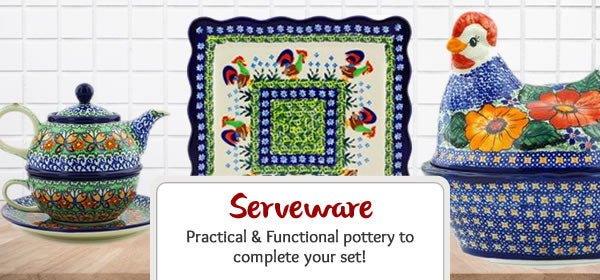
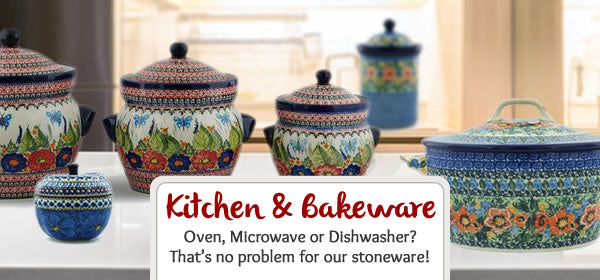

|
|
||||||||||||||||||||||||||||||
|
|||||||||||||||||||||||||||||||
|
|
|
|
|
|
|
|||||||||||||||||||||||||
| Information, Care & History |
Here
at The Polish Pottery House, we purchase our pottery directly from 5 factories
in Boleslawiec, Poland so that we can offer you the best quality possible
at great prices! Care & Use Polish pottery is safe for use in the microwave, freezer, oven and dishwasher. For oven use we recommend placement in cold oven and heating to 350° maximum. Especially important is to not place it over an open flame and to not place a frozen casserole or dish directly in the oven because it will cause an extreme temperature change and may crack the stoneware. Broken Item(s) & Return Policies If your pottery arrives damaged, contact us within 5 business days from receipt of order. Return Policy You have 7 business days from receipt of order to return merchandise. If possible, ship merchandise back in the original materials to minimize breakage. The Polish Pottery House Shipping charges are non-refundable.
History The present high standing of Boleslawiec Ceramics stems from seven centuries of work by local craftsmen and artists of pottery. Even though old pottery hardly resembled modern ceramics, both archeologists and contemporary tradesmen easily distinguish Boleslawiec Ceramics from products of lesser quality. Despite the fact that only those affluent enough and aristocracy could afford to purchase deluxe Boleslawiec Ceramics, the fame of Boleslawiec in Germany, Bohemia, and Poland extends well over several centuries. The oldest pieces of Boleslawiec pottery that are still in existence, date back to the first half of the 16th century and bear distinctive features of the Renaissance style. The technique of decorating underneath the glaze began with the age of Baroque. With this technique, decorations in the form of branches, flowers, birds and religious motifs were introduced onto the product before the process of burning and by means of special punches and only then the ornamented piece was covered with glaze. Often, pottery ordered by magnates and royalty was decorated with their coats of arms. Hence, for example, the special pottery made for Frederick the Great, King of Prussia was decorated with his initials and the crown. Growing popularity of Boleslawiec Ceramics stimulated demand which in turn led to the growing number of manufacturers set up to produce pottery. At the beginning of the 19th century, the insistence of royal administration led to the emergence of a tendency to alter traditional forms of Boleslawiec Ceramics to make it resemble then fashionable china. Nevertheless, most of the manufacturers showed considerable resistance to this trend and retained original well-established patterns. The punch technique remained the basic decorative technique. Rising fame of original Boleslawiec Ceramics, which differed in style from china and yet was considered equally refined, made it possible to increase the volumes of production and, consequently, in the middle of the 19th century, Boleslawiec became the center of the ceramic industry in central Europe. In 1844 the Boleslawiec stoneware from Jan Gottlieb Altmann's manufacture was awarded the Golden Medal on the prestigious exhibition in London. This valuable award boosted the fame of Bunzlauer Ceramics and confirmed the already high standing of these ceramics on European markets. History courtesy of the Zaklady Ceramiczne "Boleslawiec" factory
|
The Polish Pottery House Toll Free: 1-866-895-3303 © The Polish Pottery House, LLC 2001-2010, all rights reserved -Copying of pictures and text is strictly prohibited. |
||||
| Visit us on FACEBOOK! | ||||
| Follow us on Twitter! | ||||